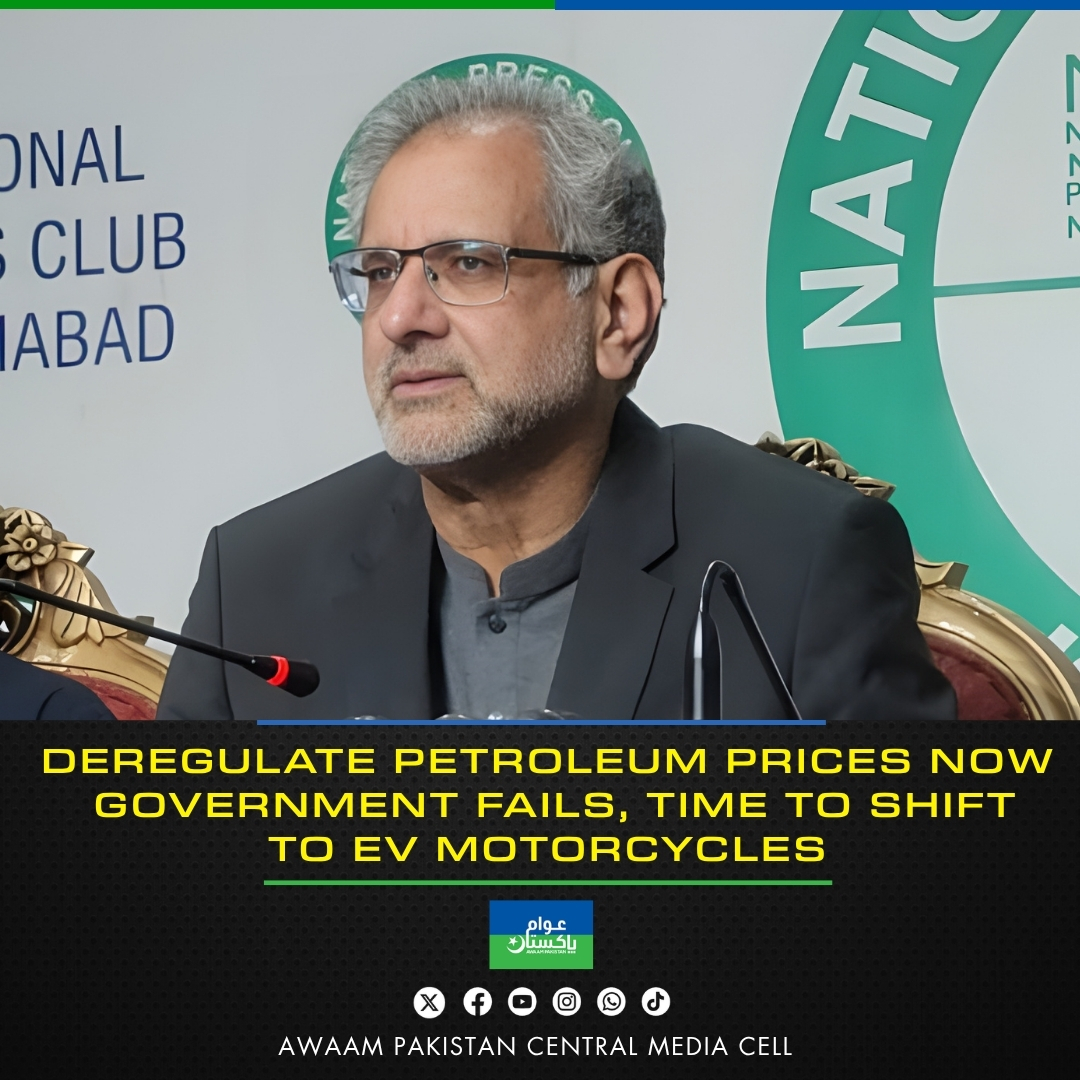
President of the Awaam Pakistan, Shahid Khaqan Abbasi, has called for deregulation of petroleum prices and the promotion of electric vehicles in Pakistan, emphasizing the need for long-term energy reforms to reduce dependence on imported fuel and ensure economic stability.
Islamabad:
President of the Awaam Pakistan Party and former Prime Minister Shahid Khaqan Abbasi has called for comprehensive reforms in Pakistan’s energy policy, urging the government to deregulate petroleum prices and introduce a long-term strategy to reduce the country’s dependence on imported fuel.
Speaking to the media in Islamabad, Shahid Khaqan Abbasi said that Pakistan cannot continue to manage petroleum prices through temporary administrative measures. He emphasized that a transparent and market-based pricing mechanism is necessary to ensure economic stability and to protect the country from repeated financial shocks caused by fluctuations in global oil markets.
He noted that rising tensions in the Middle East have pushed international oil prices upward, which has directly affected petroleum prices in Pakistan and increased the financial burden on citizens. According to Abbasi, such external developments highlight the importance of adopting sustainable and forward-looking energy policies.
The Awaam Pakistan Party president said that the government does not have the financial capacity to continue providing large subsidies on petroleum products. While relief measures may offer short-term support to the public, he said they ultimately place a heavy burden on the national exchequer and cannot be sustained for long periods.
Shahid Khaqan Abbasi stressed that Pakistan must accelerate its transition toward electric mobility, particularly electric motorcycles. He pointed out that nearly 20 million motorcycles are currently registered in Pakistan, making them the largest segment of the country’s transport sector. Encouraging the adoption of electric motorcycles could significantly reduce fuel consumption, lower the import bill, and contribute to environmental sustainability.
He also referred to the rapid growth of solar energy adoption in Pakistan, noting that many households and businesses have shifted toward solar power without significant government support. This, he said, demonstrates that citizens are willing to adopt modern energy solutions when they are economically viable.
Abbasi concluded by emphasizing that Pakistan needs consistent, transparent, and long-term policies in the energy sector to ensure economic stability, reduce dependence on imported fuel, and provide lasting relief to the people.